
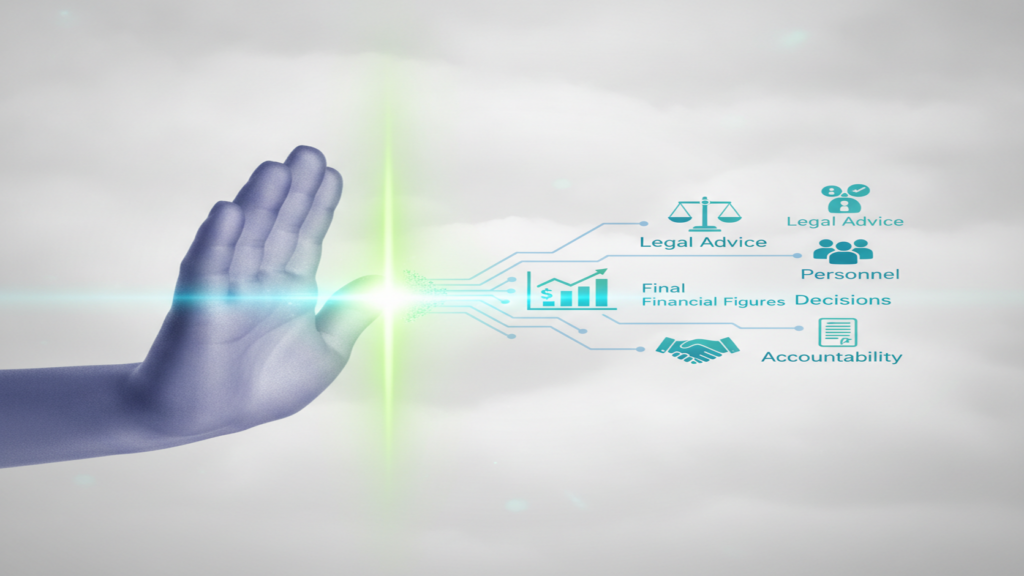
When Not to Use AI: The Tasks Your Business Should Keep Human
AI tools are genuinely useful for drafting, summarizing, searching, and triaging, and most 25-to-300-person companies can find real time savings in a few weeks. They are a poor fit for any task where a person has to be accountable for the outcome, where the final number or the final word carries legal or financial weight, or where the input data cannot safely leave your tenant.
Most AI advice for small businesses is a list of things to try. This is the other list. Drawing honest lines is what makes an AI rollout survive contact with your attorney, your CPA, your insurance carrier, and your staff. Below are the categories we consistently recommend keeping human, why, and what the safe version looks like instead.
The underlying test: who signs their name to it?
Before evaluating any specific use case, apply one question. If this output turns out to be wrong, who is accountable, and can they explain how it was produced?
A large language model produces plausible text. It does not know whether a figure is right, it does not know your jurisdiction, and it cannot be deposed. When an output feeds into something a human has to defend, that human needs to have done the reasoning, not inherited it. AI can shorten the path to the reasoning by assembling source material, pulling the relevant clause, or summarizing three hours of meeting audio into a page. The judgment stays with the person.
That distinction holds up better than a blanket “AI is risky” stance, and it gives your team a usable rule. Drafting and gathering: yes. Deciding and certifying: no.
Legal advice, contract terms, and anything touching privilege
This is the clearest line of all, and law firm clients we work with across Atlanta have been the quickest to draw it.
AI is fine for internal document review support: summarizing a long discovery production, pulling every mention of indemnification across a stack of vendor agreements, generating a first-pass timeline from a case file. That is retrieval and summarization work, and it is exactly where a properly configured Microsoft Copilot deployment earns its license cost.
AI is not fine for producing advice a client relies on, drafting final contract language without attorney review, or interpreting a statute. Models confidently cite cases that do not exist. Federal courts have sanctioned attorneys for filing AI-generated briefs containing fabricated citations, and those incidents are a matter of public record. Beyond accuracy, there is the privilege question: pasting client matter content into a public, consumer-grade AI tool may constitute disclosure to a third party, depending on the tool’s terms and how your state bar reads it.
For non-law firms, the same principle applies to your own contracts. Have AI summarize the MSA your vendor sent, flag the auto-renewal clause, and draft questions for your attorney. Do not have it tell you whether to sign.
Final financial figures, filings, and anything that gets certified
Your bookkeeper can use AI to categorize transactions faster, draft a variance narrative for the monthly package, or pull together a first draft of a board memo. Those are productivity wins, and for a 60-to-150-person company they can be worth several hours a month.
The reconciliation, the tax position, the audited number, the figure that goes on a bank covenant certification: human, every time. Not because AI cannot do arithmetic, but because certified figures require a traceable chain of work papers and a person willing to stand behind them. An AI-produced number with no audit trail is a liability in a review and a problem in a dispute.
Construction and manufacturing clients hit a version of this with estimating. AI can speed up takeoff organization and help structure a bid package. The final number that goes out the door, with margin assumptions and risk contingency baked in, belongs to the estimator who will own the job if the number is wrong.
Personnel decisions, performance, and anything involving a protected class
Hiring, firing, promotion, discipline, and compensation decisions should not be delegated to a model, and in several jurisdictions the rules around automated employment decision tools are tightening.
The risk is twofold. First, models trained on historical data reproduce historical patterns, which in employment contexts can mean disparate impact you did not intend and cannot easily detect. Second, if an employment decision is challenged, “the software scored them low” is not a defensible explanation. You need a human decision-maker who can articulate job-related, non-discriminatory reasoning.
What is reasonable: using AI to draft a job description, to summarize interview notes you took, or to prepare a neutral agenda for a performance conversation. What is not: scoring and ranking candidates, generating performance ratings, or drafting a termination rationale from HR system data. Keep the record human.
Clinical judgment, patient communication, and PHI in the wrong tool
Medical and dental practices have the most prescriptive boundary because HIPAA draws it for them. Ambient documentation and transcription tools can genuinely reduce charting time, and several are built for healthcare with a business associate agreement in place. That BAA is the gate. A tool without one has no business touching protected health information, and the consumer tier of most general-purpose AI assistants does not come with one.
Clinical judgment stays with the clinician. Diagnosis, treatment planning, medication decisions, and triage of symptomatic patients are not candidates for AI assistance in a small practice, regardless of what the marketing says. Neither is unreviewed patient-facing communication. A summary drafted for the provider to review and send is reasonable. Auto-sent clinical guidance is not.
The practical risk for most practices is not an exotic AI failure. It is a front-desk staffer pasting a patient’s chart note into a free web tool to reword a letter. That is an AI data privacy problem and a HIPAA problem at the same time, and it is why shadow-AI discovery belongs in your security program. We cover the discovery and governance side in more depth through our work on cybersecurity and with healthcare practices.
Regulated submissions, safety-critical work, and client deliverables sent unreviewed
A few more categories that consistently belong on the no list:
- Regulatory submissions and compliance attestations. CMMC documentation, OSHA reporting, licensure filings. AI can help organize evidence; a human certifies.
- Safety-critical specifications. Load calculations, tolerances, torque specs, anything where being wrong hurts someone.
- Anything sent to a client or regulator without a human read. Not because the draft will be bad, but because the review step is where accountability attaches. Treat an AI draft the way you would treat a first-year’s draft.
- Crisis and incident communication. When something has gone wrong, tone and factual precision matter more than speed, and the model does not know what your counsel has advised you to say.
How to put this in writing
The reason to write this down is that your team is already using AI, with or without a policy. An AI policy does not have to be long. The ones that work in SMBs cover five things: which tools are approved, what data categories are never pasted into any AI tool, which tasks require human review before anything leaves the building, who to ask when a situation is unclear, and what happens if someone uses an unapproved tool. Two pages is plenty.
Pair the policy with the technical side. Approved tools should run inside your tenant where your existing data boundaries apply. Microsoft Copilot, properly licensed and deployed, inherits your Microsoft 365 permissions, which is a meaningfully different privacy posture than a consumer chatbot. But it also means your permissions need to actually be correct first, and in most environments we assess, they are looser than the owner expects. Oversharing cleanup is usually the real prerequisite to a safe rollout.
Then train people on the lines above with examples from their own work. A policy nobody can apply to a Tuesday afternoon decision is not a control.
Where to start
If you are evaluating AI for small business use and want an honest read on which workflows are safe to automate and which ones should stay human, that is a conversation worth having before the licenses are bought, not after. Century Solutions Group works with Atlanta-area firms in construction, healthcare, legal, manufacturing, and professional services on exactly this: tenant readiness, permissions cleanup, shadow-AI discovery, and a written AI security and acceptable-use policy your team will actually follow.
Start with a short discovery call. We will walk through the AI tools already in use across your environment, identify the two or three workflows where a controlled rollout would pay off first, and flag the data your policy needs to put off limits. No obligation, and you will leave with a usable list either way. Reach out here to set up a time.